Can You Trust AI to Read Your Lab Results? The Honest Answer
Where AI genuinely helps, where it gets things wrong, and how to use it without putting your health or privacy at risk.
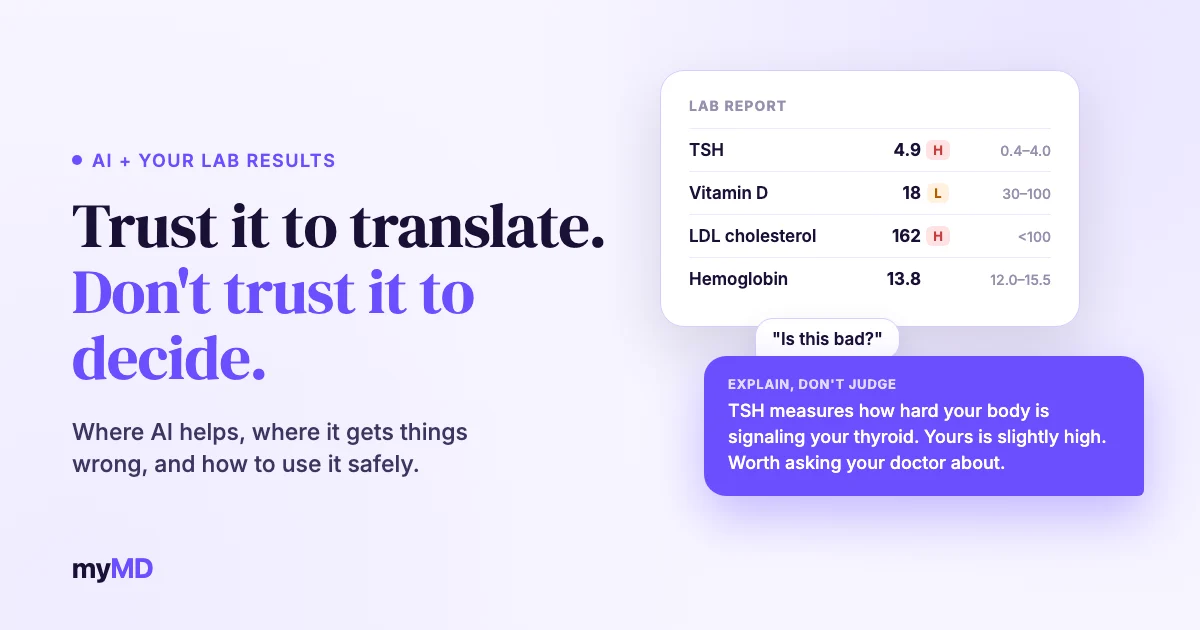
Your results land in the patient portal at 9:47 p.m.
Three numbers have a little "H" next to them. Your doctor's office is closed. The follow-up call is days away. Thanks in part to a 2021 federal rule, results like these often reach you before your doctor has looked at them.
So you do what a growing number of Americans do. You copy the results, open an AI chatbot, and ask: "Is this bad?"
You get an answer in seconds. It sounds calm, clear and confident.
Should you trust it?
The short answer: trust it to translate. Don't trust it to decide. AI is good at explaining medical terms and helping you prepare questions, and it's right most of the time. But it can be confidently wrong, it often can't see your full context, and how your data is handled depends entirely on the tool. Use it to understand your results, then confirm anything important with your doctor.
You're not the only one doing this
This is no longer fringe behavior.
- A KFF poll from early 2026 found about 1 in 3 US adults (32%) used an AI chatbot for health information in the past year.
- Of those people, 41% had uploaded personal medical information such as test results or doctors' notes. That's about 13% of all adults.
- Pew Research found a similar picture in August 2026: 34% of US adults have used a chatbot for at least one health-related reason, including making sense of lab results or a diagnosis.
- Among those chatbot health users, 47% say the information is extremely or very helpful.
So AI is clearly useful to a lot of people. The real question isn't whether people use it. It's how to use it without getting hurt.
Where AI genuinely helps
Lab reports are written for clinicians, not for you. AI is good at the part you actually need at 9:47 p.m.:
- Translating jargon into plain language ("what is TSH?")
- Explaining what a marker does in the body
- Helping you write better questions for your doctor
- Making a long report less scary to read
That's real value. Doctors interviewed by the Wall Street Journal acknowledge AI can help turn complex medical terms into language people understand.
Can AI read lab results accurately?
Mostly, but not always, and the misses matter.
It can sound sure when it's wrong. Doctors have flagged cases of chatbots misreading results, and one person caught a chatbot getting his vitamin D level wrong. In a 2024 study of AI simplifying 1,134 pathology reports, GPT-4 interpreted about 97% correctly, but some answers contained significant errors. In one case reported by the Wall Street Journal, it said lymph nodes were cancer-free when none had been tested.
It may not know your context. "Normal" ranges vary by lab, age and sex. Medications, pregnancy, past conditions and what you ate before the test can all change what a number means. A chatbot working from a pasted list of values often can't see any of that. That's exactly the gap a tool built around your own records is meant to close.
It can answer a question you didn't mean to ask. "Is this bad?" invites a verdict. A good answer to that question needs a doctor who knows you.
Many people never check. In the KFF poll, 42% of people who asked AI about their physical health did not follow up with a doctor or other health professional afterward.
Is it safe to upload your lab results to AI?
This is the one people worry about most, and the worry is justified. In the same KFF poll, 77% of adults said they're concerned about the privacy of medical information shared with AI tools. Even among people who had already shared their medical information, 65% were concerned.
Why the concern? Because every tool handles your data differently. Each one sets its own privacy policy, and it can change that policy later.
Before you upload anything to any tool, find out:
- What happens to your data after you upload it?
- Is it used to train AI models?
- Can you delete it?
- Does it remember you across conversations without being asked?
How to use AI on your lab results safely
- Ask it to explain, not to judge. "What does this marker measure?" beats "Am I sick?"
- Give it the whole report, not a few numbers. Context matters.
- Check the reference range printed on your own report. It's specific to your lab. Here's how to read a lab report step by step.
- Treat anything alarming as a reason to call your doctor, not a conclusion.
- Never change or stop a medication based on an AI answer.
- Bring the questions it helped you write to your appointment.
Where myMD fits
A note on where we stand: we build an AI health tool, so weigh this with that in mind. We've tried to be straight about the limits, including ours.
We built myMD around that last point: helping you walk in better informed, not replacing the doctor. Here's how it compares with pasting your results into a general chatbot.
| General chatbot (like ChatGPT) | Ask myMD | |
|---|---|---|
| What it sees | Whatever you paste or upload into that chat | Your full report, plus the records you keep in Health Vault |
| Your history | Only what you've shared with it | Your records, Health Score, food, workouts and cycle, in one app |
| Comparing results | You dig out old results and paste them in yourself | Compares up to five of your reports and summarizes what changed |
| Always handy | A separate tool, away from your records | In the same app where your reports already live |
| Built for | Any question on any topic | Your health, explained in plain language |
In practice, that means:
- Grounded in your actual document. When you upload a report to Health Vault, Ask myMD reads that document and explains what's elevated, what's normal and what it means. It's working from your report, not a generic internet search.
- Not a diagnosis. Ask myMD gives clarity, not verdicts. It can be wrong, and your doctor is still the one who knows you.
- Your records in one place. Reports stay in Vault, and Ask myMD can compare up to five of them and summarize what changed, instead of you guessing from memory. If your A1C came back borderline, you can see whether it's moving.
- You control what it remembers. Ask myMD only remembers things across conversations when you tell it to. Nothing is retained automatically or silently. When you ask a question, it can draw on the data in your app, such as your records, so the answer fits you.
The bottom line
Can you trust AI to read your lab results?
Trust it to translate. Don't trust it to decide.
Used that way, it can turn a confusing 9:47 p.m. portal notification into a better conversation with your doctor. That's the goal.
Common questions
Is it okay to use ChatGPT for lab results?
General chatbots like ChatGPT can explain medical terms, but they only see what you paste in. They don't have your full health history or your earlier results, and in research they've sometimes been confidently wrong. Ask myMD is built for this job: it reads the actual document in your Health Vault, knows the rest of the health data you keep in myMD, can compare up to five of your reports, and is always in your pocket when the next result arrives.
Is it safe to upload lab results to a chatbot?
It depends on the tool. Read the privacy policy first: whether your data is used for training, and whether you can delete it. If you're unsure, remove your name, date of birth and ID numbers before you paste anything.
Should I ask AI before my doctor calls?
It's fine to use it to understand terms and prepare questions. If a result is marked critical, or you feel unwell, contact your doctor right away instead of waiting.
What should I never do based on an AI answer?
Don't start, stop or change a medication, and don't skip or delay care. Those decisions belong with your doctor.
myMD is free to start. Download it on iOS or Android.
This article is for general information only and isn't medical advice. myMD doesn't diagnose or treat conditions. Always talk to your doctor about your results.
Download myMD