Why Some Runs Feel Terrible (And It's Not Because You're Out of Shape)
Same route. Same shoes. Completely different run.
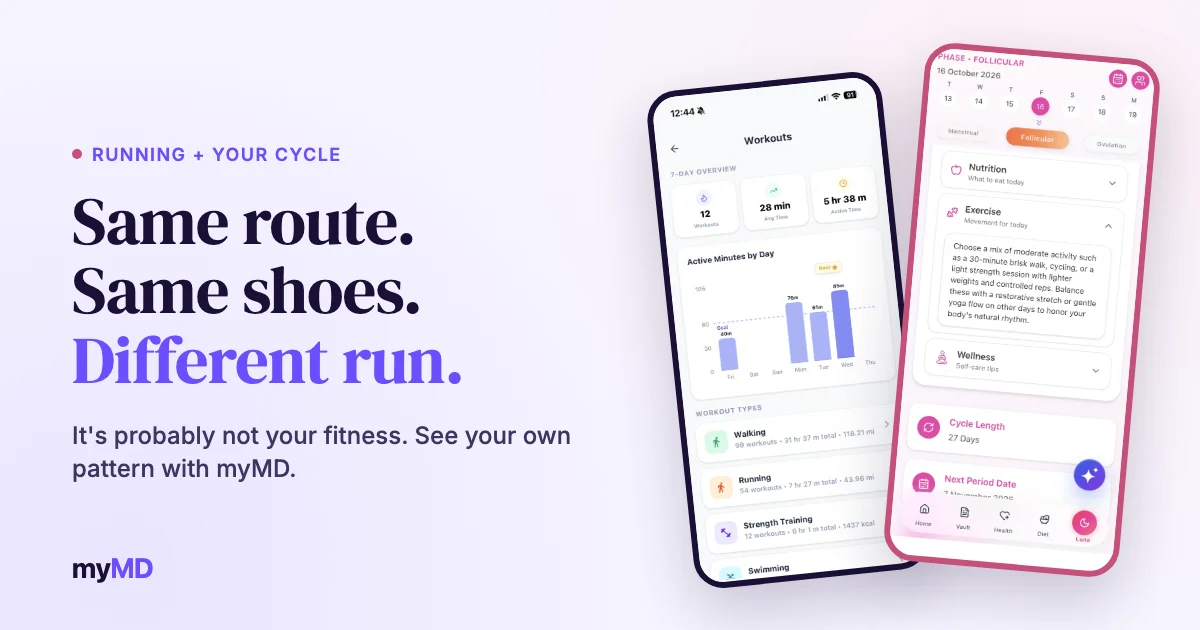
You lace up. Same route as last week. Same shoes. Same playlist.
Last week you felt unstoppable. Today, your legs feel like wet cement and a mile feels like four.
So you do what most of us do. You blame yourself. Not disciplined enough. Not tough enough. Maybe you're just bad at this.
Maybe not. Maybe you're missing a piece of the picture.
The short answer: if you have a menstrual cycle, shifting hormones can change how hard the same run feels, most often in the days before your period, when your body runs a little warmer. The effect is usually small and differs from person to person, which is why tracking your own pattern tells you more than any general rule.
The run is only one data point
Your running app knows what happened. Distance. Time. Route. Some even know a lot more.
But the reasons a run felt easy or brutal usually live somewhere else: where you are in your cycle, what you ate yesterday, how many days you've been running in a row. Those things sit in different apps, or in no app at all.
So you never see them side by side. You just see a bad run and a guilty feeling.
Does your menstrual cycle affect running?
It can, but less than you might think, and differently for everyone. A 2020 review of 78 studies found that performance may be "trivially" lower in the first days of your period than at other times, and judged most of the evidence to be low quality. The researchers' advice: look at how your own body responds instead of following general rules.
What changes more reliably is how runs feel. Here's what tends to happen across the four phases of your cycle. The timing shifts with the length of your cycle.
Menstrual phase: your period
Estrogen and progesterone are at their lowest. Some runners feel flat, crampy or heavy-legged. Others feel completely fine. If you feel up to it, running during your period is generally fine.
Follicular phase: after your period, before ovulation
Estrogen climbs. Many people feel their energy and mood lift, which can make this a good window for harder sessions, if that's what your own logs show.
Ovulation: the middle of your cycle
Estrogen peaks, then drops. Some people feel at their best around now. A few notice mild one-sided pain or bloating.
Luteal phase: after ovulation, before your period
Progesterone rises, and your core body temperature runs about 0.3 to 0.7°C higher than before ovulation. The same pace can feel more effortful, especially on hot days, and the last few days can bring PMS symptoms like fatigue and bloating.
Is it harder to run before your period?
For a lot of runners, yes, it feels harder. In the days before your period, a higher body temperature, PMS symptoms and sometimes poorer sleep can all add up. In one small study, women in the luteal phase reached exhaustion sooner when exercising in hot, humid conditions, but not in cooler ones.
That doesn't mean you've lost fitness. It means the same run is costing you more that day. Running by effort instead of pace, drinking a little more in the heat and saving your hardest workouts for days you usually feel strong can all help.
And it's not the same for everyone. Some people notice almost nothing. Some notice a lot. That's exactly the point: your pattern is yours. No article can tell you what your body does. Your own logs can.
Luna tracks all four phases and your daily symptoms. When you log how you feel, you build a record of your own rhythm, not an average of everyone else's.
Where the pattern shows up
Here's what it looks like in practice.
You log your runs in the Workout Tracker. Running is a built-in activity, with your GPS route and duration recorded. If you use Apple Health or Google Health Connect, your data syncs in too.
You log how you feel in Luna. Energy. Cramps. Mood. Cravings.
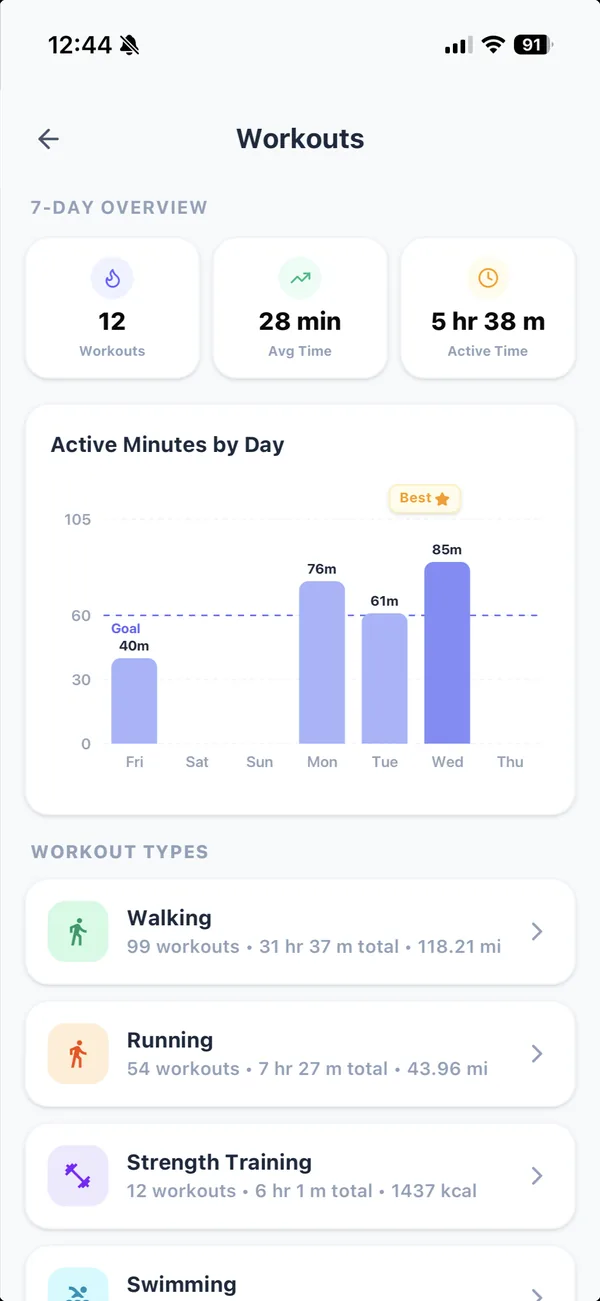
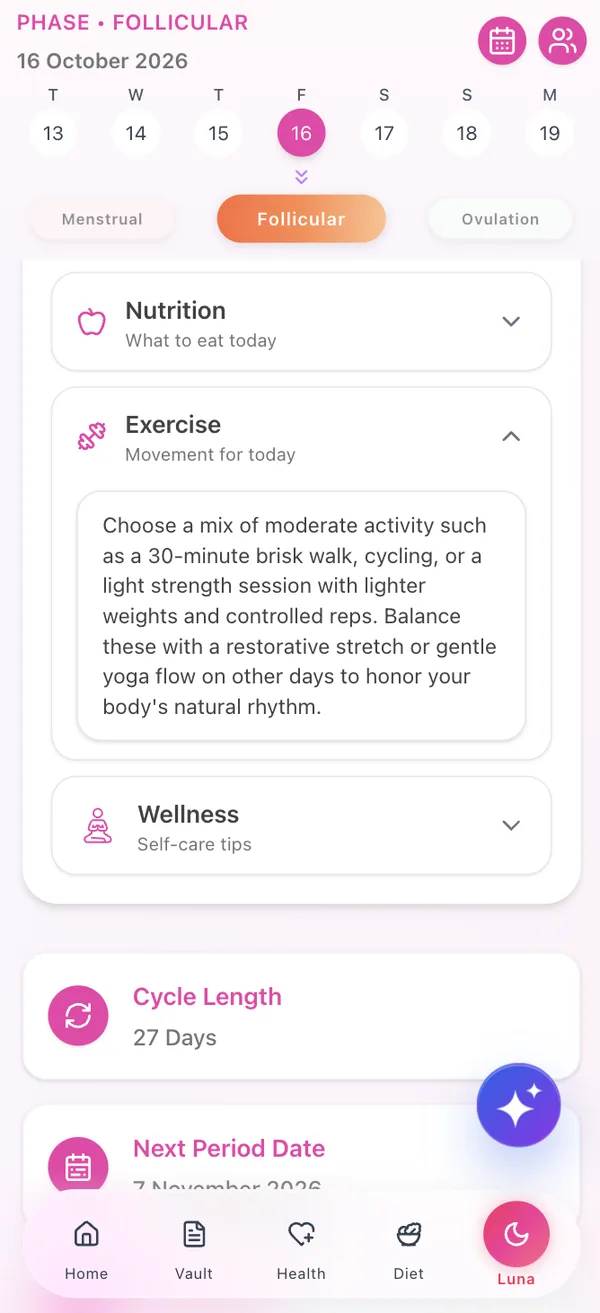
Then you open Ask myMD and type something simple:
"Why do my runs feel harder some weeks?"
Ask myMD reads across the app: your cycle in Luna, your workouts, your nutrition logs, your Health Score and more. So instead of a generic answer pulled from the internet, it can look at your data and help you see what lines up.
Maybe your hardest runs keep landing in the same phase. Maybe they follow the days you ate very little. Maybe you've run six days straight and never noticed.
It won't diagnose you. It gives you clarity. That's the difference between "I'm failing" and "oh, that makes sense."
What you can actually do with it
Once you can see your pattern, you can plan around it.
- Schedule your harder efforts when you tend to feel strongest
- Choose easier, shorter runs when you tend to feel flat, without guilt
- Spot when low fuel, not low fitness, is the problem
- Walk into race week knowing how your body usually behaves, not guessing
One thing worth knowing: if your period becomes irregular or stops while you're training hard, don't just push through it. That can be a sign your body isn't getting enough fuel for the work you're asking of it (sports doctors call this relative energy deficiency in sport), and it's worth a conversation with your doctor.
Runners spend months training their legs. Very few train their understanding of their own body.
Training for a marathon, or just your first mile
Marathon season makes this obvious. Whether you're building toward New York in November, a spring race or your very first 5K, months of training mean months of good days, bad days and runs that made no sense.
You don't need to run 26.2 to benefit from this. If you're doing a couple of miles around the block, or just trying to start, the same truth applies: you're not inconsistent, you're missing half the data. Fill in the rest, and everything gets easier.
Start small
You don't need a perfect system.
- Log your next few runs.
- Log how you feel each day in Luna.
- After a few weeks, open Ask myMD and ask what it notices.
That's it. Patterns need time and a little data.
Your body has been giving you information all along. myMD helps you read it.
Common questions
Is it OK to run on your period?
For most people, yes. There's no need to skip a run if you feel up to it. Go by how you feel, and talk to a doctor if period pain is bad enough to stop your normal activities.
Why am I slower before my period?
A higher body temperature after ovulation, PMS symptoms and poorer sleep can make the same pace feel harder. For most runners the difference is small, and it doesn't mean you've lost fitness.
Should I plan my training around my cycle?
Only if your own logs show a clear pattern. Research doesn't support one plan for everyone, so track a few cycles first and adjust based on what you see.
What if my period stops while I'm training hard?
Don't push through it. Losing your period can be a sign that you're not eating enough for the training you're doing, and it's worth seeing a doctor.
myMD is free to start. Download it on iOS or Android.
myMD is not a medical device and doesn't diagnose or treat conditions. If something feels wrong, talk to your doctor.
Download myMD